
RIGHTS WITH ROOTS
“The decision to recognise trees as living beings emerged naturally over time. ”
Telos: Your municipality is the first in the world to have recognised trees' right to live, grow and regenerate. Some see this as a symbolic gesture, while others regard it as a genuine cultural revolution. In your view, what is the deeper significance of this decision?
Michel Bourdeau: The decision to recognise trees as living beings emerged naturally over time. Located on the banks of the Outaouais River on Île Perrot, just a few kilometres west of Montreal, our small municipality of Terrasse-Vaudreuil has a population of 1 800 residents. Since its founding in 1952, residents have developed their properties within the forest. To this day, the municipal tree canopy covers more than 70% of the territory. However, urban sprawl and climate-related challenges are putting the forest cover under severe stress, particularly due to spring flooding, heavy rains, high winds longer droughts and insect infestations that are decimating certain tree species. Residents are determined to protect their natural environment. It is fair to say that the coexistence of citizens and their natural surroundings have become a cultural value, now woven into the community's daily life.
This decision was approved unanimously. At a time when politics seems increasingly polarised, do you believe it is still possible to build consensus around a long-term vision rather than around the urgency of the moment?
It is entirely possible to build consensus around a vision. In fact, this is the crucial point: taking the time to construct a sustainable vision rather than acting hastily or on impulse. A decision of this nature cannot rest solely on an immediate reaction. It must be rooted in a shared understanding of the issues, open dialogue and mutual trust between citizens and elected official. In other words, this means explaining the reasons behind the changes, listening to the realities faced by everyone and enabling citizens to participate in the various stages of the project.
It is often assumed that a small municipality can do very little in the face of major global challenges. Your experience appears to prove otherwise. Do you believe that real change can begin at the local level?
Real change must begin at the local level. A small municipality lacks the budged to tackle such challenges on its own. Yet, it is often at this level that the most concrete actions become possible. We cannot wait for the province or the country to take action, neither can we invest the same sums as large cities. Our strength lies instead in our proximity: it is easier to bring people together, explain the issues, mobilize volunteers, seek grants and call upon specialists to support the implementation of our projects.
The most innovative ideas only achieve their full value when they are shared. If an Italian municipality wished to establish a lasting partnership with Terrasse-Vaudreuil, what values do you believe it should share with your community before even considering a town twinning agreement?
Even though our realities differ, such partnerships would be desirable. There is strength in unity and we must stop believing that solutions will come solely from governments. We all face the same challenge and change must begin in our own backyard. The opportunity to share our experiences with our friends in Italy would be a valuable contribution to this shared endeavor. Such an exchange would not only allow us to showcase what we have learned but also enable us to inspire one another as we each advance - at our own level - a vision that is more respectful of Nature. All eyes are currently upon us. Many are waiting to see if our initiative bears fruit before committing to it themselves. However, it's not simply a matter of success or failure. It's about doing what's right, while keeping in mind that results will not appear overnight.
Editorial
A tree does not vote, sign contracts or bring a case before a court. And yet, in different parts of the world, the law has begun to ask whether nature should remain merely something that human beings protect, or whether it can itself become a holder of rights. The September guest of PRIMOPIANOSCALAc, Michel Bourdeau, Mayor of Terrasse-Vaudreuil, a small municipality in Québec a few kilometres from Montreal, heads the first local administration to have recognised, through a specific municipal act, trees’ right to live, grow, preserve their integrity and regenerate. The idea may sound eccentric. In fact, it comes at the end of a process that has been developing for years. In 2008, Ecuador incorporated the rights of nature into its Constitution. In 2017, New Zealand recognised the Whanganui River as a legal person. In 2022, Spain did something similar with the Mar Menor lagoon and its basin, recognising them as a subject of rights. This is not merely a matter of language. Traditional environmental protection starts from human beings: pollution of a river, the felling of a tree or the destruction of a habitat is prohibited because there is a public interest in preserving them. Granting rights to nature changes the point of view. A river, a forest or an ecosystem is no longer protected solely because of the value it has for us, but because it is recognised as having value in its own right. Naturally, there is a considerable distance between stating a principle and turning it into an enforceable right. Who represents a tree? Who decides when its right to live must give way to safety, the need to build a road or simply a landowner’s right to use their property? And, above all, what does the recognition of a right add to the environmental protection tools that already exist? This is precisely where the story of Terrasse-Vaudreuil becomes interesting. On 9 June, the Municipal Council adopted the Universal Declaration of Tree Rights, a decision that attracted international media attention. Less well known is what followed. Just over two months later, on 21 August, the municipality announced that it wished to dissociate itself from the Declaration. In its official statement, it explicitly says that it intends to “dissociate itself from the Declaration of Tree Rights” and refers to a “new framework imposed by the Compagnie des Papillons Bleus”. At the same time, it reaffirms its recognition of the tree as a living being deserving of respect and protection, and announces its intention to develop a broader approach to nature conservation, extending to all the ecosystems within its territory. The formal sequence of the two decisions remains not entirely straightforward, but for that very reason it shows how much easier it is to proclaim a principle than to build around it rules capable of working in practice. Perhaps, that is the point. There is no need to imagine that tomorrow our legal codes will be populated by oak trees and rivers endowed with the same rights as people. Legal personality, after all, is a device that the law has used for centuries to give voice and responsibility to entities that are not human beings. Companies are the most obvious example. I do wonder, however, whether our way of governing land and territory is still too closely tied to the idea that nature is first and foremost a resource to be used, with limits then imposed to determine how far it should be protected. The rights of nature seek to reverse that relationship. We still do not know how effective they are. Perhaps the key question is not whether a tree can have rights in the same way we do. What matters is understanding what changes when we stop treating it simply as a thing. Also the September cover of PRIMOPIANOSCALAc is also built around a clear division. On one side is the interviewee’s face, in black and white. On the other, the head of a classical marble sculpture treated in pop colours. Two dimensions that interact as parts of the same idea. The same logic shapes the treatment of the interviewee’s name. The typeface chosen is Didot, designed in 1784.
Mariella Palazzolo
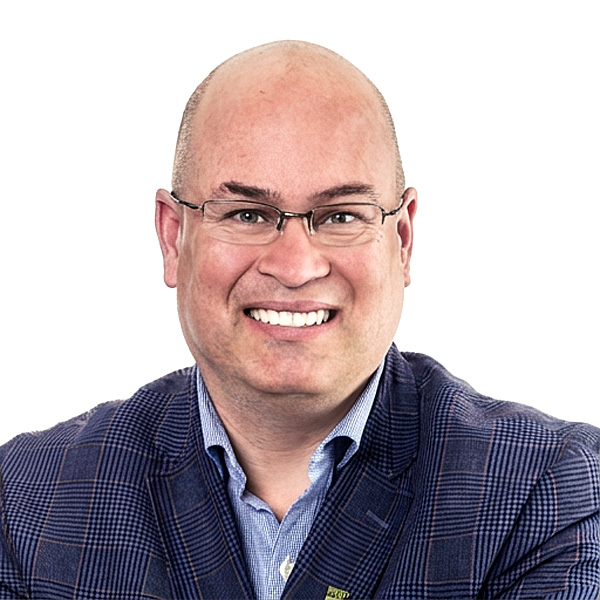
Michel Bourdeau is the Mayor of Terrasse-Vaudreuil, a municipality on Île Perrot, west of Montreal, Quebec. He has served as Mayor since 2013 and was re-elected for a fourth term in 2025, having previously served two terms as a municipal councillor. He also sits on the Council of the Vaudreuil-Soulanges Regional County Municipality and a board member of the Vaudreuil-Soulanges Regional Housing Office. During his years in office, he has been particularly involved in local infrastructure, public safety and environmental issues. M Municipal politics also runs in his family. Bourdeau has recalled that, in the 1990s, an uncle who was then Mayor of Terrasse-Vaudreuil campaigned to resolve the issue of the municipality’s level crossing, a long-standing safety concern that remained unresolved in 2022 and that Bourdeau himself brought before the Canadian Parliament’s Standing Committee on Transport, Infrastructure and Communities during a hearing on rail safety.