Against Monolithic Thinking
“So-called ‘awkwardness’, that is the ability not to fall into line, to maintain an independent position, is no longer a lever for change. On the contrary, it is often marginalised.”
Telos: You have often been described as ‘awkward’. In politics, is awkwardness still a lever for change?
Anna Paola Concia: Look, I’ll start from my recent experience with the justice referendum. It had been ten years since I last engaged in a referendum campaign on political issues, and this struck me quite strongly. I feel I can say that today we are operating within a climate of very strong polarisation. There is a clear tendency to ask people to take one side or the other, with no room for intermediate positions. In this context, so-called ‘awkwardness’, that is the ability not to fall into line, to maintain an independent stance, is no longer a lever for change. On the contrary, it is often marginalised. People who have more complex thinking, less aligned, more independent, are pushed to the margins. They find no space. It is as if there is no longer any legitimacy for those who do not fit into a binary framework. And this produces a very serious effect: the space for doubt disappears. There is no longer the possibility of cultivating a way of thinking that holds together different, even contradictory, elements. In light of the justice referendum results, this dynamic is even more evident. Public debate is no longer able to deal with complexity and ends up reducing everything to simple oppositions. For me, this is a very negative development.
On several occasions you have criticised the way political debate addresses complex issues. How would you describe today the relationship between the media, politics and the formation of public opinion?
I have been living in another country for twelve years, and this has given me a useful distance from which to observe more clearly what is happening in Italy. I have become convinced that in our country the relationship between the media, politics and the construction of public opinion is problematic, I would almost say unhealthy. Today public opinion is shaped to a great extent through social networks. And this has profoundly changed the entire information system. Traditional newspapers are heavily influenced by what happens online. They are no longer the sole drivers of the debate; they are subject to it. The online sphere, however, operates according to very specific logics: it tends to exacerbate, to polarise, to reward what is stronger, more emotional, more immediate. This leads to a highly simplified representation of reality. Public debate is reduced to basic schemes: black or white, right or wrong. But reality is not like that. It is made up of complexity, nuances, different layers. The problem is that this complexity finds no space. It is not conveyed. As a result, people find it increasingly difficult to form an independent opinion. The media prioritise what is more appealing, more forceful, even when it is less faithful to reality. And this creates a disconnect between what is reported and what actually happens. In reality, things are far more nuanced, but this nuance does not enter public debate. In my view, this is one of the most critical issues for the quality of democracy today.
New generations and new sensibilities. What remains of activism as a force capable of influencing political decisions and public choices?
I see in younger generations a very strong sensitivity to these issues: feminism, LGBT rights, questions linked to identity. There is a strong attraction to these causes, and this is certainly a positive element. At the same time, however, I also see a risk. When everything is interpreted solely through an identity lens, there is a danger of building a society made up of many separate identities. And these identities, instead of strengthening rights, can become traps. Because they fragment. They divide. And in the end, they also risk weakening the gains that have been made. I believe that today, paradoxically, we are also witnessing setbacks, both in women’s rights and in LGBT rights. For this reason, I think it is necessary to recover another perspective: that of universal citizenship rights. Rights must belong to everyone. They must be grounded in a principle of universality and equality. In recent years this principle has been partly abandoned, and in my view, this is a mistake. Differences exist and must be recognised, but they cannot become the sole foundation of politics. Otherwise, the shared dimension is lost.
What will be the decisive ground on which the credibility of leadership groups will be measured?
I think the decisive ground will be the quality of democracy. Today Western democracies are going through a phase of very deep difficulty. This is not a superficial or temporary crisis: it is something more structural, concerning the relationship between citizens, institutions and democratic values. Within this crisis we also see the growth of anti-Western sentiments. And note, I am not referring only to external, geopolitical phenomena, but also to something that concerns our own societies. There is an increasingly widespread questioning of some fundamental pillars of liberal democracies: the rule of law, pluralism, individual freedoms, the value of representative institutions. These sentiments also stem from a perceived distance between citizens and politics, from a sense of distrust and disillusionment. But the risk is that this criticism turns into an outright rejection of the Western democratic model. And this opens up a very dangerous space, because the alternatives that emerge are not always more democratic. On the contrary, they often call into question rights and freedoms we once took for granted. We live in free societies, and this is an immense legacy, built over time. But today this legacy can no longer be taken for granted. For this reason, I believe the real challenge for leadership groups will be twofold: on the one hand, to rebuild trust, making democracy more credible and closer to people; on the other, to firmly defend the fundamental values of liberal democracies, without ambiguity. Credibility will be measured precisely here: in the ability to hold these two dimensions together, without yielding either to populism or to closure. It is a decisive contest, because it concerns not only the functioning of institutions, but the very future of our societies.
Editorial
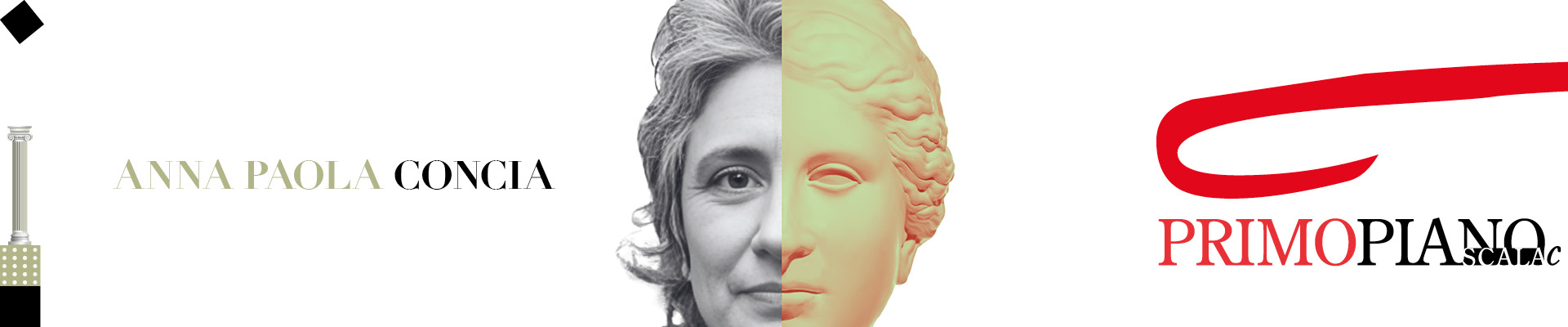
This interview is a little different from the usual, for a simple reason: it took place in person. You can sense it throughout the text, because there is no distance, none of that mediation of writing that can sometimes stiffen words. From the conversation with this month’s guest of PRIMOPIANOSCALAc emerges a real voice, attentive, measured, clearly sincere. This impression becomes even more significant when one considers the moment in which the conversation took place, just a few days after the defeat of the referendum on the judicial system, for which, after many years since her last involvement in a political referendum campaign, Anna Paola Concia committed herself, and quite extensively. Her words, perfectly relevant even nearly a month later, had not yet acquired any distance and retained a direct connection with what had only just happened. For this very reason, even now, they come across as sharper and, in some passages, more vulnerable. Within this frame, a reflection takes shape on the way we inhabit the public sphere today. Those who try to step outside a rigid logic of alignment often end up on the margins. Not because they lack arguments, but because the context has long ceased to accommodate them. Today, adherence is asked for, expected, while complexity is avoided. What is demanded is immediate simplification, not a way of thinking capable of holding together different elements. The result is a gradual shrinking of debate, but also, unfortunately, of a civilised conversation over dinner among friends. I would hesitate to say that people speak less, but they certainly speak worse. The ability to address issues without trivialising them has been lost, as has the recognition that important questions rarely sit on just one side. Those who behave differently, who believe in dialogue, in free and open exchange, end up becoming awkward. One wonders how many of our readers recognise themselves in these words, in the unease of those who sometimes almost hesitate to speak out, and then think to themselves, what’s the point? As Anna Paola explains, this is also linked to the way public opinion is formed today. Information is no longer only what the media choose to report, but what manages to circulate, to assert itself, to generate reactions. In this process, anything more complex is left behind, becoming invisible. The issue is not only the presence of social media, but the kind of language that prevails, a language that privileges what is immediate, recognisable, divisive, and struggles to convey reality in its entirety. The result is a gap between what happens and what is perceived. It is within this framework that the theme of identity-based struggles emerges. The problem, Concia tells us, is not the recognition of differences, which remains a fundamental step. The problem arises when identity becomes the sole criterion through which reality is interpreted, when everything is reduced to belonging. In that case, there is a risk of constructing a collection of separate claims. Each group defends its own space, but struggles to find common ground with others. This weakens the possibility of having a real impact, because politics requires a shared language, not continuous fragmentation. Anna Paola’s call for universal rights should be read in this light, as an attempt to rebuild a point of convergence. I will now leave you to enjoy this excellent interview, which touches on political engagement, the fight for rights, and the quality of democracy, among many other truly awkward issues. At the end of the conversation, the first adjective that came to mind to describe Anna Paola was no longer awkward, but fearless. Would you agree? In the 2026 series of PRIMOPIANOSCALAc covers, the image is built around a clear division. On one side, the interviewee’s face, in black and white. On the other, the head of a classical marble sculpture treated with pop colours. Two dimensions that interact as parts of the same idea. The same logic guides the interviewee’s name: the first name takes on one of the tones of the statue, while the surname is black. The typeface chosen is Didot, designed in 1784.
Mariella Palazzolo
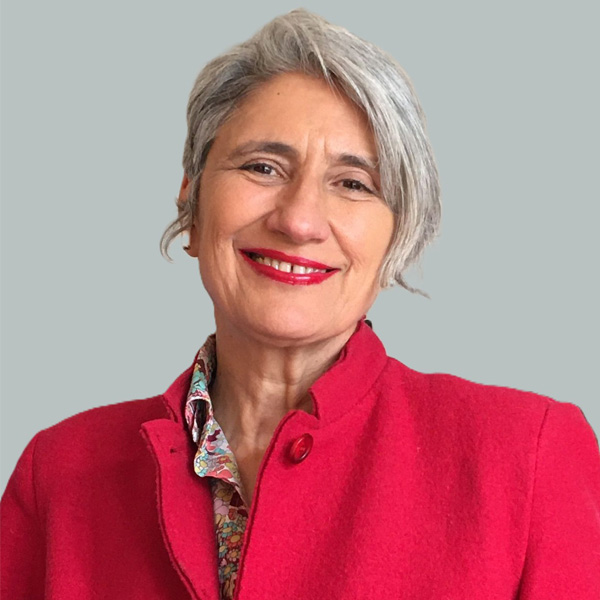
Anna Paola Concia has held positions of responsibility across all the main Italian institutions: Councillor at the Municipality of Florence, President of Agensport in the Lazio Region, Member of Parliament, and adviser to three Ministers. Since 2014 she has been living in Frankfurt, where she works on economic, institutional and cultural relations between Italy and Germany: an experience that has profoundly transformed her. For the past ten years she has been Coordinator of the Organising Committee of Fiera Didacta Italia, the Italian edition of Didacta International, the world’s leading trade fair dedicated to education, which she brought to Italy. She is married to Ricarda Concia, a German criminologist. Curious about life, a quality that has led her “to live many lives, and very different ones”, starting over several times. Deeply committed to the value of freedom, especially freedom of thought, which she cultivates with care. She says of herself: “I graduated in sports science. I have been involved in sport since I was three years old, when I was given my first pair of skates. For a time, sport was both my life and my work. I was an athlete, a tennis instructor and a coach. Sport has certainly shaped my approach to life in a profound way. My great passion is bringing to life projects I truly believe in.” Anna Paola is unforgettable also for her bright red lipstick, which over the years, through battles of every kind, has become her hallmark.