
FRANCIS. A MODERN MAN
“Because he raises the question of the full realisation of one’s personal life, a question that, eight centuries later, has become part of our shared inheritance.”
Telos: Why do you describe Saint Francis as “the first modern man”?
Mauro Magatti: In a small town in central Italy, at the heart of the Middle Ages, Francis, a layman, reads the Gospel for the first time and interprets the Scriptures as something that speaks to him personally, as a free individual. Remaining within the religious framework and in obedience to the Church, he nevertheless raises a decisive question: the full realisation of his own personal life. Eight centuries later, that question has become part of our common inheritance. Since the second half of the twentieth century, each of us has come to feel both entitled and obliged to fulfil our existence as fully as possible. For this reason, Francis feels strikingly close to us and to our own experience. His story is inseparable from its religious setting, yet the radical nature of his response continues to challenge us, because it expresses a longing for fullness that remains deeply human today. From this perspective, Francis is the man who follows desire to its very end, understanding desire not as a means of appropriating reality, but as a vocation that calls us towards the fullness of life.
In the life of Saint Francis there is a powerful relational dimension, with others, with nature and with God. Why does this vision still matter for people today?
Francis clearly understands the fundamentally relational nature of human life. He conceives himself in relation to the cosmos, and therefore to God, not as an abstraction, but as something revealed through relationships with others, his brothers, and with nature. We can see this thread clearly in the legacy of Pope Francis and in his encyclicals Fratelli tutti and Laudato si’. Francis’s vision is profoundly relevant today because we are living through a deep anthropic crisis. For a long time, we imagined that unlimited growth could continually expand the freedom of action of each individual, conceived as an independent atom detached from what preceded it, what surrounds it and what will follow. The anthropic crisis, expressed in geopolitical disorder, ecological emergency, cultural fragmentation and social tension, reveals how unfounded this purely individualistic view truly is. With his understanding of life and humanity as intrinsically relational, Francis anticipates insights that science itself has been confirming for more than a century: everything is connected to everything else, and our freedom cannot evade that responsibility.
In your work you develop the idea of social generativity. What do you mean by “bringing into being through loving”?
The paradigm of social generativity seeks precisely to translate this vision into concepts capable of guiding contemporary social life. If I were to define social generativity today, I would describe it as “bringing into being through loving.” To bring into being means recognising that human beings, woven into the network of relationships that surrounds them, possess a creative and transformative capacity. Driven by desire, we are always inclined to go one step further, impelled by the urge to leave a mark upon the world. The problem, however, is that this creative energy, so celebrated by modernity, often remains indifferent to its consequences: on the one hand it damages the world, and on the other it corrodes relationships. To bring into being through loving therefore means not only pursuing innovation, creativity and even transgression, but also loving what we bring into the world and allowing ourselves to be loved in return, so that we ourselves may be transformed. This relational structure is inherently dynamic. For this reason, the idea of generativity approaches even concepts such as community or solidarity with a certain caution, not because they lack value, but because we have too often imagined them in static terms. The paradigm of generativity unfolds through four stages: desiring, bringing into being, caring for, and letting go. This cycle is intrinsically dynamic and connects life and death — the arc within which human life unfolds. It is an attempt to safeguard freedom, which today is increasingly under strain, while situating it within a relational framework animated by living dynamism. To recall Erikson: during adolescence we experience the departure from family bonds, the exploration of the world, the thrill of novelty and the endless search for new experiences. But eventually the moment arrives when we must decide where to direct our creative energy and which relationships we wish to bring into existence. In this sense, the anthropic crisis we are experiencing may be read as an adolescent crisis: freedom can endure only if it matures into a deeper awareness of itself.
Why, in your view, is generativity not simply a personal virtue but a genuine social project capable of transformation?
Generativity concerns not only the individual person, but also social forms and, ultimately, the model of development in which we live. We speak of generativity because we must find something anthropologically as powerful as consumption. Human beings have always consumed, but the consumer society of the twentieth century was deliberately constructed: we invented advertising, shop windows and credit cards. Social generativity is therefore not merely a matter of good intentions. It represents a cultural shift capable of opening the way to a profound socio-economic and institutional transformation. It is a social project that invites us to rethink the way we live, consume and produce, beginning with a fundamental question: what are the goods we truly need, goods capable of increasing happiness while countering the dramatic inequalities that surround us? This work unfolds across three principal areas. The first concerns a radical rethinking of education and formation, from the earliest months of life through to retirement. In the age of artificial intelligence, caring for the person and cultivating our cognitive and cultural capacities is a priority that cannot be underestimated. The second concerns organisational models, whether profit, non-profit, public or private, which must become more capable of mediating between the demands of the systemic structures that organise our social life (efficiency, productivity, innovation) and the human need for meaning, relationship and attachment that belongs to the concrete lives of real people. Much of this work must take place within organisations themselves, which bear considerable responsibility in shaping a generative society. Finally, there is the question of dwelling and the physical places in which life unfolds. As we increasingly speak about artificial intelligence, we are rediscovering the importance of physical presence, together with the emotions and attachments it carries, which are essential elements of human intelligence. All this requires concrete rootedness. It means reflecting carefully on the places in which we live and inhabit the world, where relationships can once again take root and find the conditions for their fulfilment. The spread of remote and hybrid working may well offer a valuable opportunity to rethink our cities, our rhythms and our spaces, all of which are central to the path towards a generative society.
Editorial
As the Franciscan eight-hundredth anniversary is celebrated, the figure of Francis of Assisi once again speaks to our present. In the heart of the Middle Ages, in a world shaped by rigid hierarchies and a social order that seemed unchangeable, he performs a gesture that is radically new: he reads the Gospel as a word addressed to his own personal freedom. Not as a system of abstract rules, but as a call to shape one’s life. In this sense, Francis appears as one of the first modern men. He places at the centre the question of the full realisation of human existence, a question that today feels deeply our own and that in recent decades has come to resemble almost a right. Yet Francis’s modernity lies not only in this attention to the singularity of the person. It resides also, and perhaps above all, in his relational intuition. His experience leaves no room for the isolated individual: human beings exist within a web of relationships that binds them to others, to creation and to God. Everything is relationship. In an age such as ours, which for so long cultivated the idea of the self-sufficient individual, this insight appears strikingly contemporary. It is precisely on this ground that the reflections of this month’s guest of PRIMOPIANOSCALAc, Professor Mauro Magatti, take shape. In his sociological work, Francis becomes a precursor of an awareness that is returning with renewed force today: the human being is not an atom detached from the world, but a reality that is constitutively relational. This perspective becomes even more meaningful when considered in light of the historical moment we are living through. Magatti speaks of an anthropic crisis, not simply one crisis among many, but a crisis that concerns the very idea of the human being that has guided modernity. For decades we imagined limitless growth based on the expansion of individual freedom, as though each person could act without constraint in relation to others, to nature and even to the consequences of their own actions. Today this vision reveals all its contradictions. Geopolitical tensions, social fractures and environmental emergencies suggest that the problem is not merely economic or political; it is anthropological. Certain episodes of contemporary life make this point particularly clear. The Epstein case, on which Magatti has written an illuminating article, is not merely a judicial or moral scandal. It exposed how power, wealth and personal vulnerability can intertwine in opaque networks capable of exerting pressure and blackmail upon public figures and institutions. It is not simply the story of a man and his crimes; it is a sign of a broader fragility affecting democratic systems and their growing exposure to increasingly sophisticated forms of manipulation. A similar fragility appears on another level when Magatti turns his gaze to Europe, a continent he describes as “without a compass”, suspended between the need to accelerate in order not to fall behind in global competition and the difficulty of rediscovering a shared vision of its own future. Without such a compass, even the most urgent decisions risk being reduced to merely technical or provisional responses. Perhaps this is why, eight centuries later, the voice of Francis of Assisi continues to resonate. In the 2026 cover series of PRIMOPIANOSCALAc, the image is constructed around a clear visual division. On one side appears the interviewee’s face in black and white; on the other, the head of a classical marble sculpture rendered in vivid pop colours. Two dimensions that converse as parts of the same idea. The same visual logic governs the presentation of the interviewee’s name: the first name echoes one of the tones of the statue, while the surname remains black. The chosen typeface is Didot, designed in 1784. With Easter approaching, our best wishes to you all.
Mariella Palazzolo
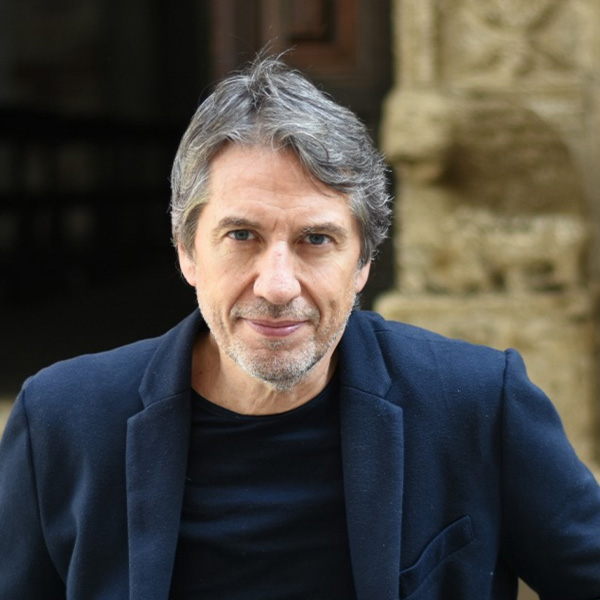
Mauro Magatti is a sociologist and economist. A full professor at the Università Cattolica del Sacro Cuore in Milan, in the Faculty of Political and Social Sciences, he teaches Social and Economic Processes of Contemporary Capitalism. Founder of the Archivio della Generatività Sociale, he promotes—through a critical reading of contemporary social structures—a new way of thinking and acting at the personal, organisational and political levels. Formerly president of Common APS, he currently chairs Poetica – Foundation for Social Generativity. Among the positions he has held are Dean of the Faculty of Sociology at Università Cattolica (2006–2012), member of the Central Commission for Charity of Fondazione Cariplo (2014–2023), and Secretary General of the Social Weeks of Italian Catholics (2017–2023). Since 2006 he has lived at Eskenosen – Hospitality, Beauty, Spirit, a volunteer organisation dedicated to supporting migrants and asylum seekers on their path towards full autonomy. A columnist for Corriere della Sera and Avvenire, his most recent books include Generare libertà. Accrescere la vita senza distruggere il mondo (2024) and Macchine celibi. Meccanizzare l’umano o umanizzare il mondo (2025), both written with Chiara Giaccardi.