WHERE PEOPLE MINGLE
“Chuormo is the place where people meet. ‘Où les gens se mêlent’, as they say in Marseille.”
Telos: Italian cinema continues to be financed with public funds for works that struggle to reach audiences. Why do you believe that an independent group of “pirates” from Testaccio has managed to interpret viewers’ tastes better than the entire institutional film supply chain?
Chuormo: Simply because we actually meet them. Chuormo was born in Testaccio, created by filmmakers in service of filmmakers: it is not a matter of having “understood the audience”, but of being embedded within a community and a territory. Chuormo exists because it is rooted in people. People who return, recognise themselves, take part, and believe that a different way of making cinema is not merely useful, but necessary. The system funds films without audiences because audiences are not part of the decision-making process. We reverse the order: first the community, then the film. For us, the film is like the fire around which people gather, not a product to be consumed, but a shared moment. We want to restore to cinema its value as a collective art form and a shared human experience. Because Chuormo is the place where people meet, “où les gens se mêlent”, as they say in Marseille.
Two thousand members, full houses even on the slowest days, short films reaching economic sustainability before distribution. What does Chuormo really demonstrate: that the crisis lies in cinema… or in those who manage it?
Chuormo demonstrates that the true driving force today is community. As in the novel that inspires us, Chuormo exists so that people might “get involved”, so that they choose to “row together to escape the same galley”. Not passive spectators, but individuals engaged in a shared process. The crisis stems from a system of management that neglects real economic sustainability, outsourcing it to external funding and prior approvals. We start again from there: building sustainability first, so that we can make cinema without having to ask anyone’s permission. When the community sustains the system, cinema becomes free and continuous once more.
Institutions continue to reason solely in terms of enterprises and tax credits. Why do you think cultural policy is so reluctant to acknowledge that today’s most vibrant production emerges outside its own criteria?
Cultural policy is reluctant because acknowledging what happens outside its criteria would mean admitting that those criteria no longer capture the most vital part of the sector. Today, the most dynamic production emerges in hybrid forms: associations, communities, cultural spaces, informal yet structured networks. Chuormo does not reject economics, it practises it. For this very reason, we are currently gathering expressions of interest from companies that wish to finance a genuine cultural supply chain, one that is traceable and capable of delivering measurable impact on audiences and on the local area.
Looking ahead, does Chuormo aim to grow or to radicalise? In other words: do you want to become a replicable model… or remain a rebellious body that challenges the system every time it produces culture?
Growth and radicalisation are not opposites. The idea behind Chuormo is replicable, but it cannot be copied without the community. The numbers, the formats, even the economic models can be studied; what cannot be replicated by decree or through simple investment is associative life, the real bond between people and territory. A company could not reproduce it tomorrow without going through that process, not because resources would be lacking, but because the form would be missing. Chuormo grows precisely in this way: by building models that are exportable only if they are rooted, capable of adapting to places and people. It is within this tension that we remain radical and, at the same time, sustainable.
Editorial
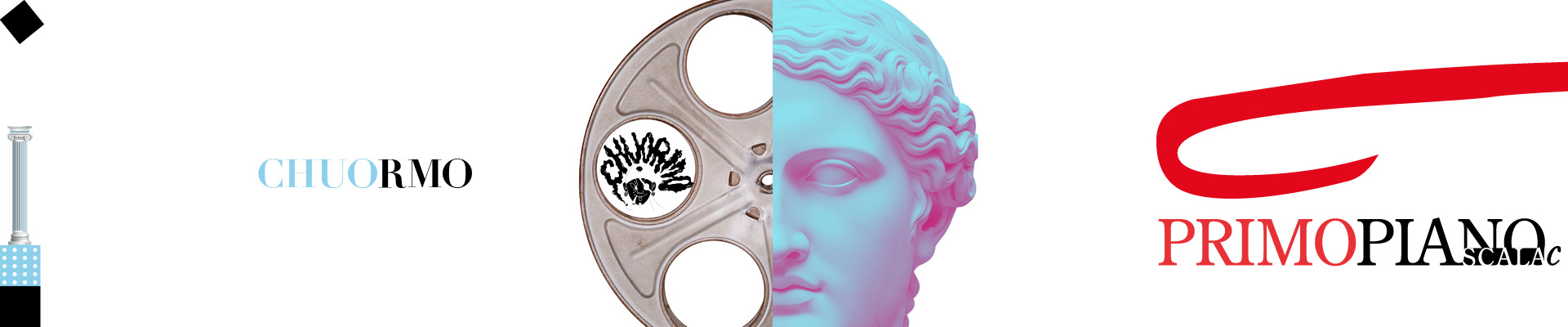
There is no photograph of this month’s PRIMOPIANOSCALAc guest. Not as a graphic choice, but as a matter of coherence. When the subject is not an individual but a collective, a single image becomes reductive. It happened in February 2024 with One Army; it happens again today with Chuormo: realities that reject personalisation and assert a plural form. It shifts attention from the author as brand to the infrastructure that makes the work possible. In the case of Chuormo, that infrastructure has a precise name: community. The central issue of Italian cinema is not a shortage of resources, but the growing distance between production and audience. In recent years, the supply chain has structured itself around mechanisms in which funding precedes the encounter with the viewer, and at times replaces it. The work itself is born already secured by a contributory system that safeguards its economic balance regardless of its actual quality. Experiences that position themselves “outside the supply chain” are not romantic gestures, but attempts at structural rebalancing. The premise is straightforward: first build a stable community, then produce. It is not about intercepting an abstract demand, nor about financing the usual names, but about inhabiting a concrete cultural territory. Chuormo has a Manifesto, a declaration of intent that clearly sets out this specific idea of cultural community. The “Cinema fuori filiera” project has articulated this necessity with clarity: not to reform a system that displays structural limitations, but to generate a parallel circuit capable of integrating thought, production and distribution. It has created a genuine architecture: sustaining a work through a system of ongoing activities, screenings, workshops, memberships, that generate micro-resources and, above all, real participation. The results emerging from these experiences point to a difficult-to-dispute fact: when the offer is coherent and rooted, audiences respond. Cinemas filled on marginal days, steady participation, productions approaching sustainability from the outset. The issue inevitably becomes regulatory. Between the Budget Law and the 2026 Milleproroghe Decree, the legislator intervened on the cinema tax credit with a significant change of direction. The suspension of the instrument was avoided, but a spending cap was confirmed, introducing a “floating ceiling” mechanism that allows the Ministry of Culture to refinance the €610 million Fund during the year according to demand. At the same time, controls were strengthened to counter abuses and distortions. It was necessary. For too long the tax credit had been perceived as an almost inexhaustible source of funding, capable of supporting works that did not always demonstrate industrial solidity or genuine cultural impact. Yet technical revision alone is insufficient unless accompanied by deeper reflection on the subjects that today generate cultural value. The regulatory framework continues to recognise production companies as the central actors, according to a twentieth-century industrial model. And yet associative realities exist that think, produce and distribute, while simultaneously generating continuous communities. Chuormo does not propose an escape from the system. It proposes another logic: density instead of scale, participation instead of automatism, sustainability built from below rather than guaranteed in advance. Numbers can be replicated; the bond between people and territory cannot. No reform will restore vitality to the sector unless spaces are rebuilt in which people choose to become involved. We cannot conclude without paying due tribute to Jean-Claude Izzo and his novel Chourmo, redolent of harbours, red wine, noisy friendships and sudden melancholy. In the Marseille dialect, “chourmo” means the crew, the band of those who row together even when the sea is rough. In this sense, Chuormo seems to gather precisely that energy: culture not as pedestal, but as a long table around which people sit, argue, quarrel and then raise a glass. In the 2026 series of PRIMOPIANOSCALAc covers, the image is constructed around a clear division. On one side, the interviewee’s face in black and white. On the other, the head of a classical marble sculpture treated in pop colours. Two dimensions in dialogue as parts of the same idea. The same logic guides the name of the interviewee: the first name echoes one of the tones of the statue, while the surname is black. The chosen typeface is Didot, designed in 1784. This time, to represent the face of Chuormo, we chose a film canister.
Mariella Palazzolo

Chuormo is an independent film collective and production company. It conceives, produces and distributes cinema under the pirate flag, which also serves as its emblem. Founded in 2022 through the coming together of a group of young filmmakers, Chuormo takes its name from a seafaring term meaning “crew”: a manifesto for rowing in the same direction and navigating out of the shallows together. Alongside the production of independent films, both documentary and fiction, presented at national and international festivals, in 2023 the collective established Chuormo APS, an association dedicated to supporting emerging filmmakers. In April 2024 it opened a venue in Rome’s Testaccio district, transforming a disused tailor’s shop into a screening room and cultural hub. Here, Chuormo curates screenings, conversations with filmmakers, live podcasts, festivals, workshops and interdisciplinary programmes spanning cinema, performance and music. Through a weekly and monthly schedule, it has fostered a vibrant and engaged local film community. All of this is carried out in complete artistic and financial independence, without institutional funding, sustained by the work of its members and the support of its audience. Today, Chuormo stands as a point of reference for a new generation of filmmakers and viewers who see cinema not merely as a product, but as a political and human act, a space for sharing, cross-pollination and cultural resistance.