WHAT IS BEHIND THE SCREEN?
“Satire has the function, through irony and paradox, of giving a free critical judgement; of revealing what is behind the screen.”
Telos: In your personal and professional life, what was the turning point that led you to choose cartoons as a way of recounting the present?
Emilio Giannelli: I have always had a passion for drawing, ever since I was a child. Perhaps because I am left-handed and was forced by my teacher to write with my right hand - as was customary in my day - drawing with my left hand represented a space of freedom. When I was very young, I did a lot of drawings: starting from caricatures of my classmates and teachers to those published in local and contrada’s newspapers. In Siena, there is a great tradition surrounding the Palio. My profession had nothing to do with drawing and caricatures. As a solicitor, I joined the legal department of Monte dei Paschi at the age of 26, taking over as head of the department in the early 1980s. It was a demanding job that I did with great passion. I enjoyed it. But in my spare time, I always drew. It was a relaxing diversion. I began collaborating with national newspapers with La Repubblica's Satyricon, then moved on to the comments page of Il Quotidiano until 1991, and finally landed at Corriere della Sera. I couldn't say no to editor Ugo Stille's offer of a cartoon on the front page of Corriere. As I said, I like caricatures, and for me, political cartoons with caricatures of leaders are like bringing the comments of the man in the street to life with a satirical drawing. As a Tuscan living in Tuscany, in Siena, I just need to listen to people, who are always ironic and sarcastic, and I have no shortage of inspiration!
How would you describe your second job?
“Political cartoonist” is the term generally used, and it is certainly accurate. Some people say “satirical illustrator” and others “satirical commentator”. I think the first is the best, because the others lack any reference to politics, which is the main theme of my drawing. In fact, my “social commentary” cartoons are very rare.
What affects the possibility of doing satire today?
The main factors – political, cultural or social – that affect the possibility of doing satire are the events of coexistence. The continuous evolution of politics and customs, obviously in both a positive and negative sense, cannot fail to be the subject of satire, since, in my opinion, satire has the function, through irony and paradox, of giving a free critical judgement; of revealing, on every occasion, what is behind the screen.
The crisis of democracy through a cartoon. How do you imagine it?
There is no need to imagine it. I intended to give a concrete sign of the crisis of democracy when I drew a cartoon, published in Corriere, in which we see Trump, President of the United States, climbing onto the famous Statue of Liberty and blindfolding her.
Editorial
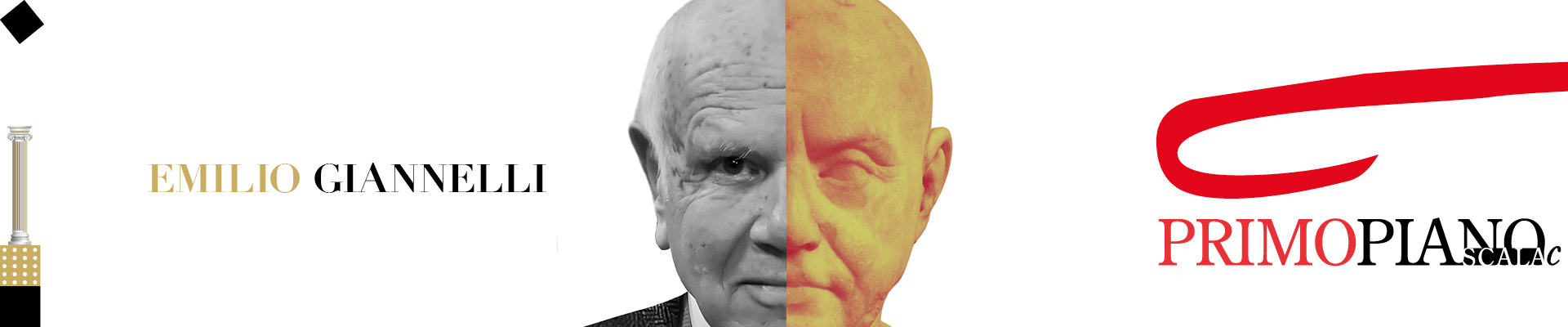
There is an ancient gesture in satirical drawing: lifting the veil to reveal what lies beneath. Authentic satire does not console or soften: it disturbs, cracks and lays bare. Who better than the first interviewee of PRIMOPIANOSCALAc in 2026, Emilio Giannelli, one of Italy's most reputed political cartoonists, to clearly explain this function of satirical cartoons? Giannelli recounts his journey with disarming simplicity. Drawing began as a space for personal freedom and over time became a tool for interpreting the present. Political satirical cartoons have a long history, intertwined since their origins with the birth of the modern public sphere. As early as the 18th century, when periodicals began to spread and public opinion took on increasing importance, satirical images established themselves as a privileged tool of social and political criticism, capable of reaching even those who were excluded from full literacy. In England, William Hogarth was among the first to systematise visual satire as a moral and political narrative. His famous series of narrative engravings, such as A Rake's Progress (1735) and Marriage A-la-Mode (1743–45), are not mere caricatures, but veritable cycles of denunciation against the corruption of the aristocracy, the cynicism of social alliances and the degradation produced by power and money. In works such as Gin Lane (1751), Hogarth uses excess and deformation to denounce public policies that encouraged the spread of gin among the working classes, transforming a social issue into a visual indictment of the state and the economic elites. The power of these images lies in their immediate legibility: every detail contributes to constructing a political discourse without the need for words. In 19th-century France, with Honoré Daumier, the satirical cartoon became openly political and took on a confrontational dimension with power. Published in newspapers such as La Caricature and Le Charivari, his lithographs directly targeted King Louis Philippe and the ruling class of the July Monarchy. His most famous work, Gargantua (1831), depicts the sovereign as an obese giant devouring the riches of the people while expelling appointments and favours. Emilio Giannelli's work fits into this tradition. His cartoons are never a pure exercise in style, but a critical device based on listening to social reality. As he himself suggests, satire arises from coexistence, from the observation of behaviour, from the widespread irony that permeates everyday language. The political cartoon, in its apparent immediacy, is the commentary of the man in the street, but filtered through a historical and cultural awareness that makes it a public, responsible act. Drawing leaders, distorting their features, placing them in paradoxical situations, means restoring them to their human measure, removing them from media sacralisation, bringing them back within the perimeter of collective judgement. In this sense, the satirical cartoon becomes an instrument for verifying democracy. The image evoked by Giannelli, the Statue of Liberty blindfolded by a president who should embody its values, is emblematic of this function. A little anecdote. After several attempts, I finally managed to speak to Mr Giannelli on the phone. The pleasant conversation immediately conveyed the natural warmth and sharp sense of humour that accompanies his cartoons. We came to a simple agreement: I’d send him the questions by text message, and he’d reply in writing. A few days later, the manuscript arrived, written entirely in block letters, with that unmistakable handwriting that readers of the Corriere have known for years because it is the same as that used in his cartoons. In an era of pervasive digitalisation, receiving handwritten answers gives the feeling of a slight time shift, an unexpected return to the materiality of the gesture. With Emilio Giannelli, we are launching the new cover design for PRIMOPIANOSCALAc. In the 2026 series, the image is built on a clear division. On one side is the interviewee's face, in black and white. On the other is the head of a classical marble sculpture treated with pop colours. Two dimensions that interact as parts of the same idea. The same logic guides the interviewee's name: the first name takes up one of the shades of the statue, while the surname is black. The font chosen is Didot, designed in 1784. Finally, the new Telos Analisi e Strategie logo stands out in the top left corner. We hope you like both.
Mariella Palazzolo
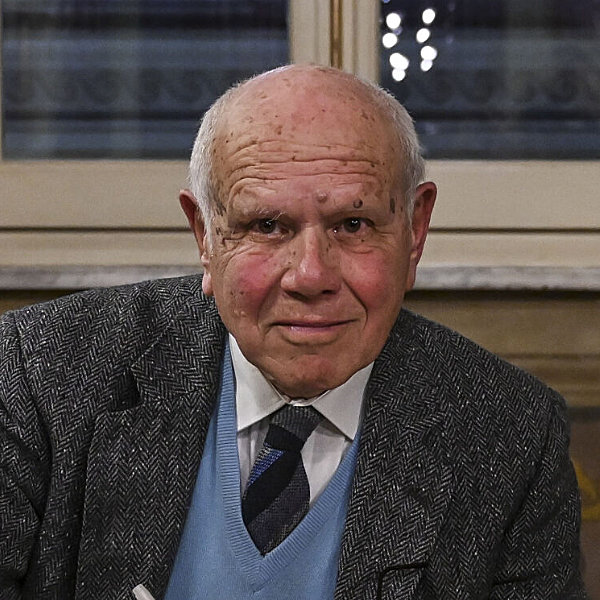
Emilio Giannelli is an Italian satirical cartoonist. He has cultivated a passion for drawing and caricature since he was young. He began his career as a cartoonist collaborating with newspapers and magazines, including La Repubblica (in particular the Satyricon supplement) and Il Quotidiano. Since 1991, he has been a regular contributor to the political cartoon section of Corriere della Sera, initially on the comments page and then on the front page. Over the years, he has collaborated with various newspapers and magazines, including Epoca, L'Espresso and Panorama. His cartoons have been collected in numerous volumes, some of which are dedicated to reinterpreting recent Italian political history through satirical drawings. The most recent is Un'Italia da Vignetta (2022), which collects 30 years of cartoons for Corriere della Sera, written together with journalist Paolo Conti. He was born in Siena in the Contrada del Drago to Fernando and Elena Falaschi, daughter of Enrico Falaschi, mayor of Siena at the end of the 19th century and later a member of parliament. He was prince of the Feriae Matricularum of the Sienese student fraternity in 1960. Very attached to city life and the tradition of the Palio, in 2018 he created the banner for the Palio della Madonna di Provenzano. A law graduate, he worked as a solicitor and, since 1962, held positions of responsibility in the legal department of Monte dei Paschi di Siena and later in the MPS Foundation. The Facebook page “Capire Giannelli” has been dedicated to him, which since 2015 has been analysing his cartoons in a semi-serious way. Giannelli was born on 25 February 1936. So, we are just in time to wish him a happy birthday. A serious one!